
KP Launches Door-to-Door Survey
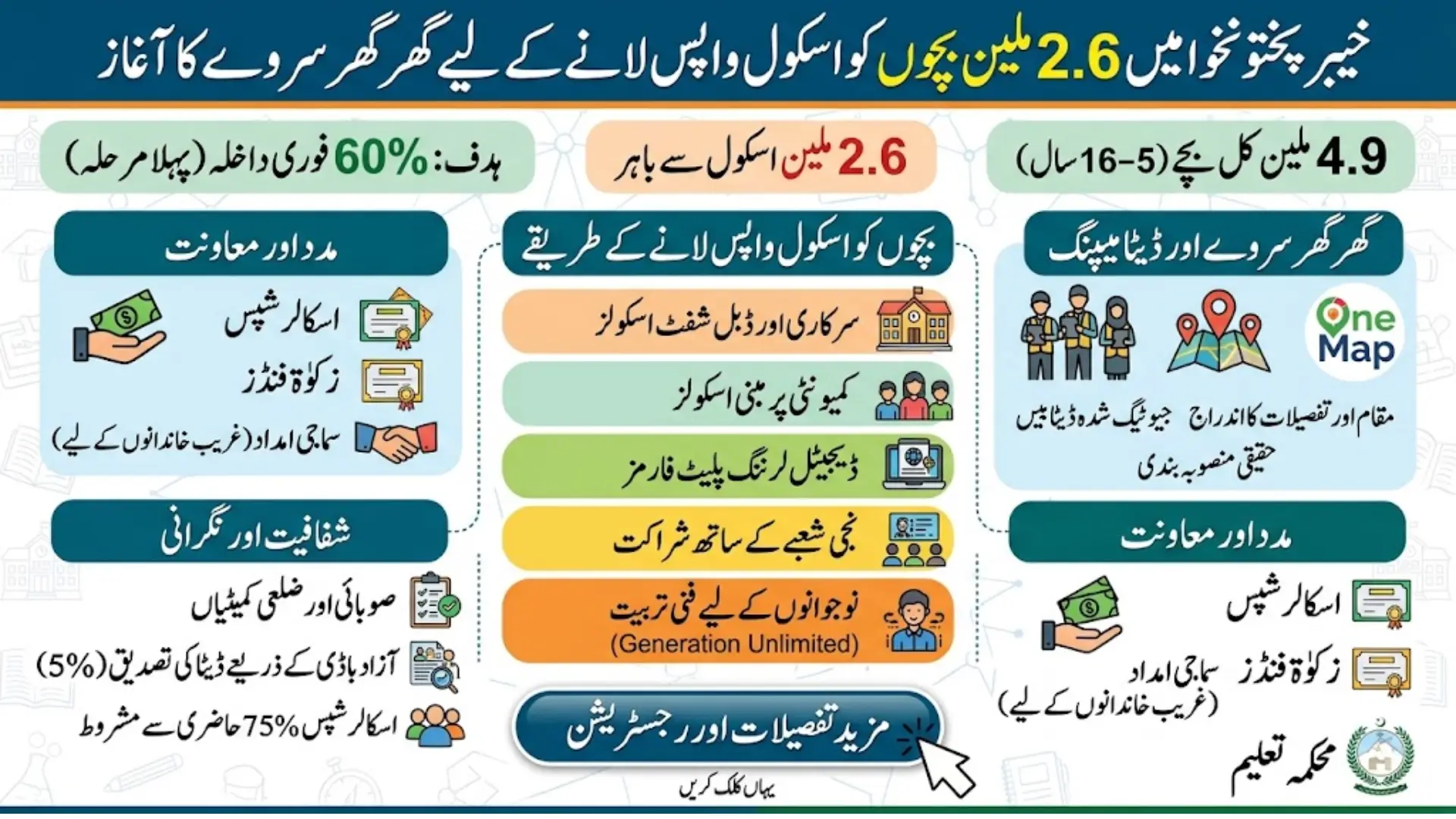
KP Launches Door-to-Door Survey is rolling out one of its most ambitious education drives in years: a province-wide, door-to-door headcount of children who are not in school. The goal is simple to state but hard to execute: find every out-of-school child, map exactly where they live, and get them back into a classroom.
The plan was formally approved after a memorandum of understanding (MoU) was signed in the presence of Chief Minister Sohail Afridi, signaling that this isn’t just an education department initiative it has buy-in at the highest level of provincial government.
Why a Door-to-Door Survey, Not Just Desk Data?
Pakistan’s education numbers are notoriously unreliable once you move past headline statistics. Enrollment records exist, but they rarely match reality on the ground — children drop out mid-year, families migrate, and many kids were never registered in the first place.
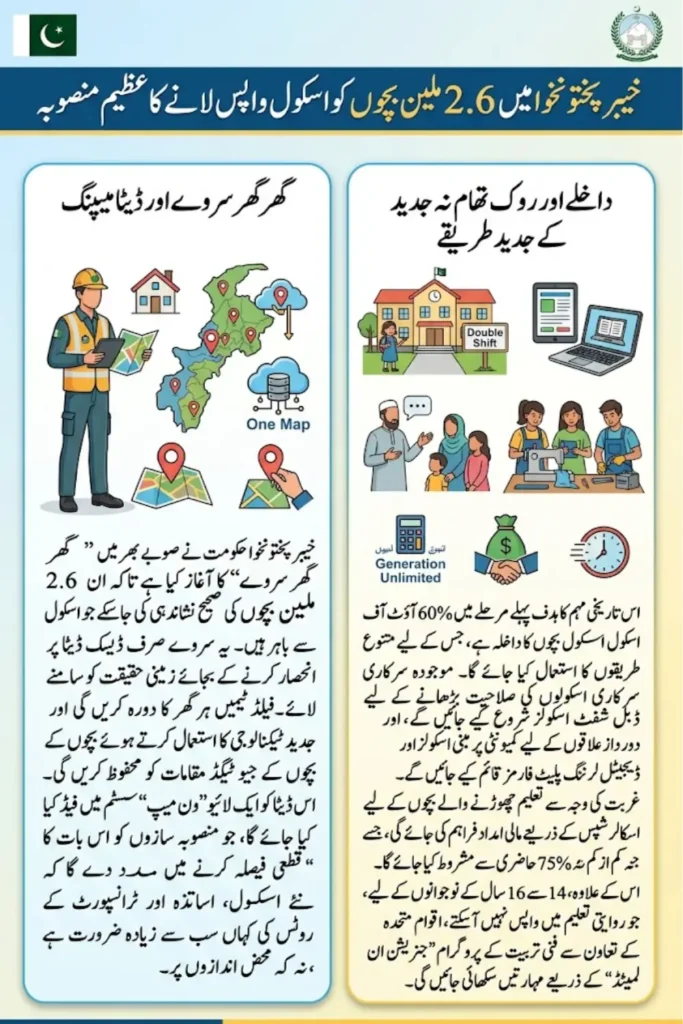
That’s the gap this survey is designed to close. Rather than relying on old census extrapolations, field teams will physically go house to house across the province to count out-of-school children and pin their exact location. The data will feed into a new “One Map” system — essentially a live, geo-tagged database that planners can use to decide where new schools, teachers, or transport routes are actually needed, instead of guessing.
Four Departments, One Table
What makes this initiative different from past attempts is the interdepartmental structure behind it. Four government departments are jointly responsible for execution:
- Elementary and Secondary Education Department — the lead on enrollment and curriculum
- Local Government Department — for reaching households at the union council level
- Health Department — since many out-of-school children also fall outside routine health monitoring
- Social Welfare Department — to identify and support the poorest and most vulnerable families
Bringing health and social welfare into an education survey is a meaningful shift. It suggests planners understand that a child stays out of school for more than one reason — poverty, health issues, and lack of documentation often overlap.
The Scale of the Problem
The numbers explain the urgency. Khyber Pakhtunkhwa’s 2023 census counted roughly 4.9 million children aged 5 to 16 across the province. Of these, the education department estimates that 2.6 million — more than half — are currently out of school.
That single statistic puts KP among the provinces with the steepest out-of-school child crisis in the country, and it’s the reason officials are treating this as an emergency-style rollout rather than a routine data-collection exercise.
The Plan: Phase One Targets 60% Enrollment
The government isn’t starting with a multi-year rollout. In the first phase, officials aim to enroll 60% of identified out-of-school children immediately — a target that will require fast coordination between the survey teams and school placement systems.
Interestingly, the survey won’t stop at school-age children. Data on children under five will also be collected, giving the province a head start on planning school capacity years before those children reach enrollment age.
How the Children Will Actually Be Enrolled
Given that 2.6 million children can’t all fit into existing classrooms overnight, the plan leans on a mix of delivery channels:
- Government schools — absorbing as many children as current capacity allows
- Double-shift schools — running morning and afternoon sessions to double capacity without new construction
- Community-based schools — smaller, localized setups in underserved areas
- Digital learning platforms — for children in remote or hard-to-reach locations
- Private-sector partnerships — bringing private schools into the enrollment push
For children dropping out specifically because of poverty, the province plans to offer scholarships, Zakat funds, and other social assistance, addressing the financial barrier directly rather than just the access barrier.
Vocational Training for Teenagers
Not every out-of-school child can realistically return to a traditional classroom especially teenagers who’ve already missed several years of schooling. For this group, KP is partnering with the United Nations on “Generation Unlimited,” a program aimed at teenagers aged 14 to 16, offering vocational and skills training as an alternative pathway into economic life.
This is a practical acknowledgment that re-enrollment isn’t one-size-fits-all a 15-year-old who has been out of school for years needs a different offer than a six-year-old just starting out.
Accountability Built Into the Design
Government initiatives in Pakistan have a well-documented credibility problem: plans announced with fanfare often quietly stall. This one appears to have accountability measures baked in from the start:
- Provincial and district-level steering committees will monitor progress in real time
- An independent body will verify 5% of the surveyed data, adding a check against inflated or fabricated numbers
- Scholarship disbursements will be tied to at least 75% attendance, meaning financial support isn’t a one-time payout but an ongoing incentive to stay in school
That attendance-linked scholarship model, in particular, is worth watching — it shifts the program from simply counting children to actively retaining them.
Also Read Article Link Here: 8171 Wazifa Check Online By CNIC 2026 – Complete Guide for BISP and Ehsaas Beneficiaries
What This Means Going Forward
If executed as designed, the KP Launches Door-to-Door Survey could give Khyber Pakhtunkhwa something it has never really had: an accurate, address-level picture of exactly which children are missing from school and why. That’s a precondition for fixing the problem —you can’t plan schools, teachers, or transport routes around a number you don’t trust.
The real test, as always, will be implementation. Whether the “One Map” system stays updated, whether the independent verification actually catches bad data, and whether attendance-linked scholarships get paid on time will determine if this becomes a model for other provinces or another well-intentioned plan that fades after the launch event.
This article covers Khyber Pakhtunkhwa’s newly announced out-of-school children survey, based on details shared following the MoU signing under Chief Minister Sohail Afridi.