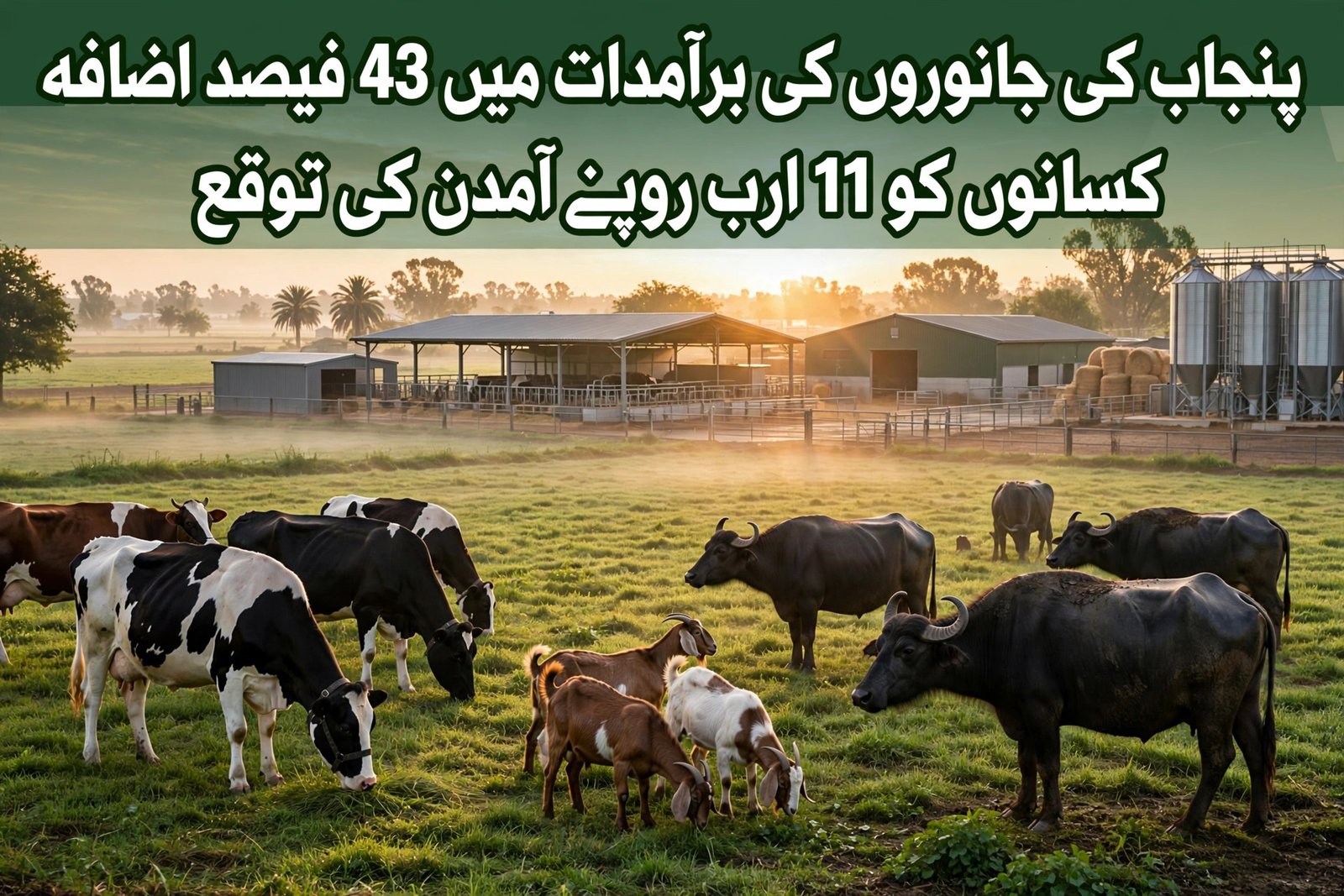
Punjab’s livestock sector has recorded a remarkable 43 percent increase in animal exports, with around 400,000 animals prepared for export within a single year and rural livestock farmers expected to earn Rs 11 billion, according to a provincial government handout.
The achievement is being credited to the Livestock Card scheme launched by Chief Minister Maryam Nawaz Sharif, under which farmers receive Rs 27,000 per animal to meet feed and fodder expenses. So far, 129,581 animals reared under the Livestock Card scheme have already been exported.
Punjab Animal Exports: Key Details
| Detail | Information |
|---|---|
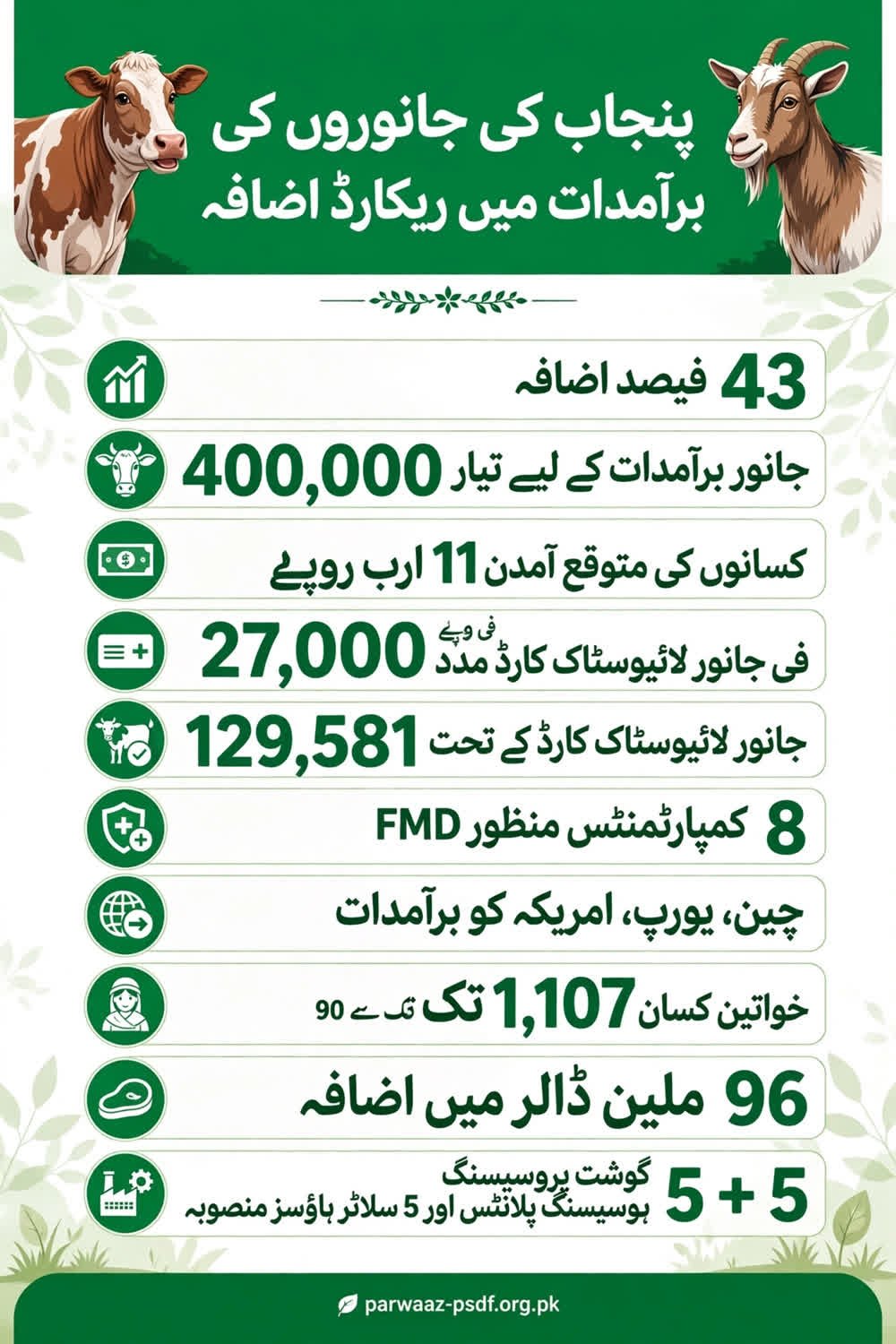
| Increase in animal exports | 43 percent |
| Animals prepared for export | Around 400,000 in one year |
| Expected farmer income | Rs 11 billion |
| Support per animal (Livestock Card) | Rs 27,000 for feed and fodder |
| Animals exported under Livestock Card | 129,581 so far |
| FMD compartments notified | 8 (7 more planned this year) |
| Target export markets | China, Europe and the United States |
How the Livestock Card Scheme Drove the Surge
Under the Livestock Card scheme, farmers receive interest-free support of Rs 27,000 per animal, enabling them to buy wanda (animal feed), silage, mineral mixtures and other essential supplies. The scheme has also provided free animal tagging and anti-foot-and-mouth disease (FMD) vaccination.
The government’s handout highlighted that the number of rural women farmers registered under the Livestock Card scheme has grown from just 90 to 1,107, reflecting wider participation. Meat exports have also increased by USD 96 million in one year due to the scheme.
Export Infrastructure and Investment Plans
To support exports to China, Europe and the United States, the provincial government has notified eight FMD-free compartments and plans to establish seven more this year. It also plans to set up five meat-processing plants and five modern slaughterhouses, alongside meat-packing facilities and commercial and corporate feedlots.
The government will provide Rs 19 billion in financing subsidies for investments in the integrated livestock value chain, while private investment worth Rs 65 billion is expected in the meat value chain. Punjab will also establish its first FMD vaccine production unit through a public-private partnership, attracting private investment of Rs 28 billion.
Livestock Connect System and District-Wise Figures
Through the Livestock Connect system, authorities have linked 1,725 fattening farms with 20 export slaughterhouses, 88 meat exporters and 34 meat traders. District-wise export figures include 20,000 animals from Lahore, 24,297 from Bahawalpur, 12,529 from Faisalabad, 21,000 from Gujranwala and Gujrat, 27,000 from Multan, 22,000 from Sargodha and 2,661 from Sahiwal.
The chief minister said the government aims to connect Punjab’s livestock farmers with national exporters and international online markets, and to establish the province as a regional livestock hub.
FAQs About Punjab’s Animal Exports Growth
By how much have Punjab’s animal exports increased?
Animal exports from Punjab have recorded a 43 percent increase, according to the provincial government’s handout.
How many animals were prepared for export in a year?
Around 400,000 animals were prepared for export within a year; rural farmers are expected to earn Rs 11 billion.
What support do farmers get under the Livestock Card scheme?
Farmers receive Rs 27,000 per animal for feed and fodder expenses, along with free animal tagging and FMD vaccination.
Which markets is Punjab targeting for livestock exports?
China, Europe and the United States, supported by notified FMD-free compartments and new processing infrastructure.
What new facilities are planned?
Five meat-processing plants, five modern slaughterhouses, meat-packing facilities, feedlots, and Punjab’s first FMD vaccine production unit under a public-private partnership.
Final Thoughts
A 43 percent jump in animal exports marks a major milestone for Punjab’s livestock sector. With the Livestock Card scheme, expanding FMD-free compartments and heavy investment in processing infrastructure, the province is positioning itself as a regional livestock export hub, and farmers stand to earn Rs 11 billion.